

Signs Your Mobile Home Needs Leveling: What to Look For Under Your Manufactured Home
The most common signs your mobile home needs leveling are doors that stick or swing on their own, windows that bind, new diagonal cracks at the corners of doors and windows, and a home that feels like it tilts from one end to the other. Outside, look for buckled skirting and tilted or sunken piers. You push your bedroom door closed, and it swings back open. You set a glass on the counter and watch it lean. None of these feel catastrophic on their own, but together they tell you something specific: the ground under your home has shifted.
These aren’t random maintenance annoyances. They’re the visible signs of a manufactured home whose steel I-beams have shifted out of alignment, a condition that develops gradually as the soil beneath the piers compresses, expands, or erodes. It’s one of the most common issues manufactured homeowners face, and it’s correctable. Re-leveling resets the home’s frame to a level plane.
Knowing the warning signs early keeps small shifts from turning into expensive structural damage.
Warning Signs Your Home Is Out of Level
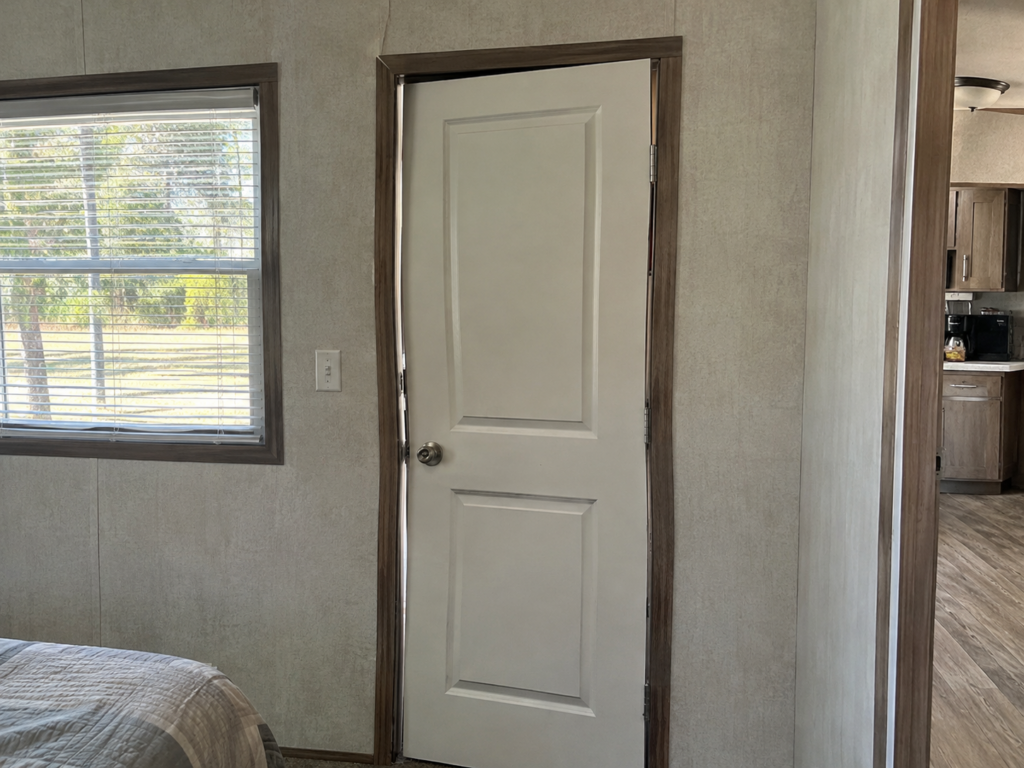
Interior Symptoms
The first signs almost always show up inside, around the parts of the home most sensitive to frame movement: doors, windows, and wall joints.
When a manufactured home’s I-beams shift even slightly, the door frames they support go with them. If your doors stick or swing open and closed on their own, it’s usually a frame problem, not a hinge or humidity issue. No amount of planing or hardware adjustment will fix them for good while the shift remains.
Windows respond to the same racking force. A double-hung or sliding window that suddenly takes real effort to open, or no longer sits flush in its track, is telling you the wall framing around it has twisted just enough to bind the sash.
A simple test you can do yourself: place a marble on a hard floor in several rooms. If it rolls the same direction in room after room, the whole home is likely tilted, which is what re-leveling corrects. If it only rolls in one spot, you may have a local floor dip instead (more on that below). You can also hold a level against the tops of your interior door frames; a frame that’s clearly out of plumb is a direct read on the I-beam beneath it.
Think of your home’s steel I-beams like a spine. When the spine is aligned, every connected structure sits where it should. When one vertebra shifts, the whole system compensates, and you feel it in places that seem unrelated. A manufactured home works the same way: when the I-beams drift out of plane, every wall, door frame, and window opening registers the strain.
Exterior Symptoms
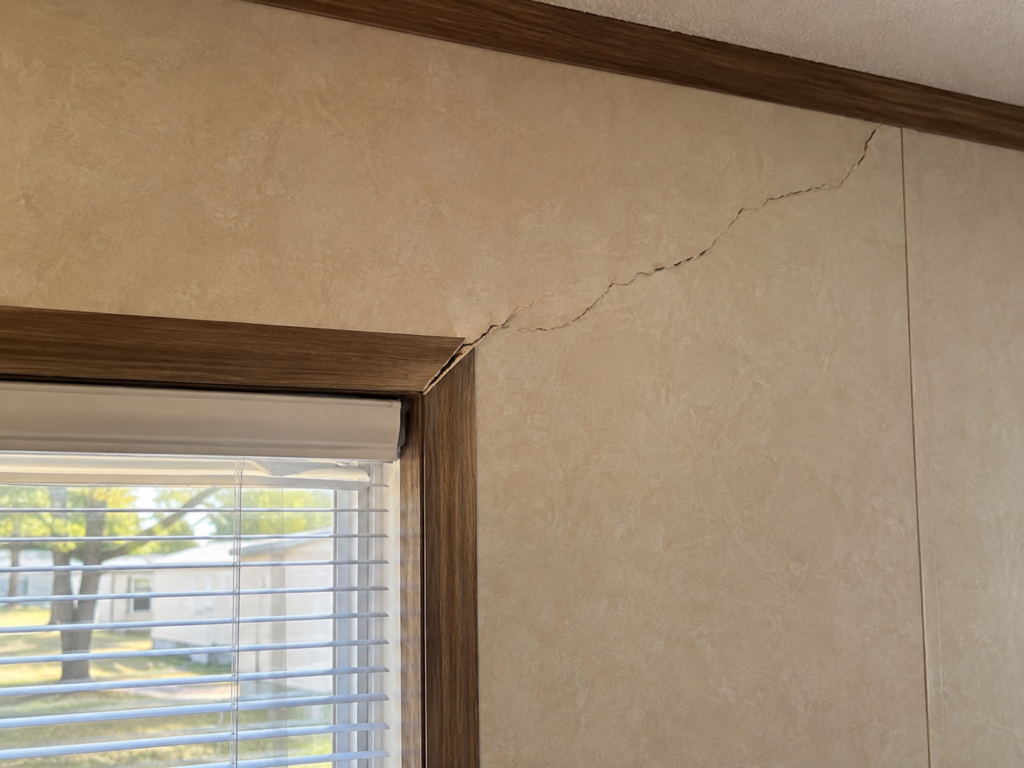
Step outside and walk the perimeter. Skirting that buckles, bows, or pulls away from the home often means the home has moved relative to the ground. Diagonal cracks in the siding running from the corners of windows or doors are a more serious signal that the wall panels are under shear stress.
Pier settlement is the mechanical cause behind most of these symptoms. Manufactured homes rest on a series of concrete or steel piers, and those piers sit on soil that’s never entirely still. Clay soils expand when wet and contract when dry, and poor drainage lets water pool under the home and soften the soil under specific piers. If you’ve been wondering whether your mobile home is sinking, the more accurate description is that individual piers are settling at different rates, which tilts the frame instead of dropping it evenly.
One clarification matters for setting expectations: re-leveling addresses the home’s steel I-beams and frame. It brings the piers back to a level plane across the entire support structure. It does not fix localized floor humps, dips, or squeaks in the subfloor or flooring. Those come from damaged or deteriorated floor components and need separate repair work. What re-leveling will do is correct the structural tilt that’s making your doors bind and your drywall crack.
- Doors and windows: Sticking entryways and windows that bind in their tracks are the most common early signs.
- Drywall and siding: Diagonal cracks running from the corners of frames show the structure is under shear stress.
- A tilted home: A consistent slope from one end of the home to the other, or gaps opening where walls meet the floor or ceiling, means the frame has drifted off level.
What Happens If You Wait
A small frame shift doesn’t stay small. Gravity, wind, and seasonal soil movement don’t pause while you decide whether to call. Every week the frame sits out of alignment, the wall studs and roof trusses connected to it carry load at angles they weren’t designed for, and the damage builds on itself.
Structural movement and moisture go hand in hand. Once a frame shifts enough to open gaps in roof seams or wall joints, water finds its way in, and the mold and rot that follow raise both repair costs and health risks.
The damage tends to progress in a predictable pattern:
- Structural warping and seam separation: As the frame holds its out-of-level position, wall framing and roof joints twist. Cracked drywall, separating trim, and bowing panels can eventually become structural damage that takes far more than re-leveling to correct.
- Plumbing and gas line stress: Supply and drain lines under a manufactured home are routed with specific slopes. When the frame shifts, those lines flex at their connections. Leaks can go unnoticed for months while they soak insulation and subfloor, and gas line stress is an immediate safety concern.
- Rising costs: A re-level today costs a fraction of what major repairs cost later. Waiting turns a maintenance expense into a reconstruction project.
f you’re wondering how much it costs to level your home, re-leveling pricing is based on your home’s size and how far out of level it is, and it’s a fraction of what the repairs that follow long-term neglect will cost: replacing rotted floor joists, removing mold, fixing plumbing, and repairing the roof.
On Level Services has local providers across Washington, Oregon, Idaho, Colorado, and Florida. Find your local On Level provider for a free quote.
Benefits of Re-Leveling
When the frame comes back to level, the effects ripple through the whole home. Doors that have been binding latch cleanly again. Windows slide without resistance. New cracks stop forming. Re-leveling won’t erase damage that has already happened, but it removes the force that was causing it.
- Moisture protection: A level frame keeps wall and roof seams tight, which keeps water out. Drainage matters too: under the federal installation standards in 24 CFR Part 3285, described by the HUD Manufactured Home Installation Program, the site must be graded so water doesn’t collect under the home. If poor drainage caused your home to settle, fixing it after a re-level helps the correction last.
- Easier sales and financing: Homes installed after the federal installation standards took effect on October 20, 2008, must be properly supported, leveled, and anchored. A home that has settled badly out of level can raise flags with inspectors, appraisers, and lenders, and a re-level is usually the first step before adding HUD-compliant tie-downs or an FHA/VA foundation system.
- Structural longevity: A frame that carries load evenly across all its support points wears at a steady rate. A frame that has been tilted for years concentrates stress at specific joints and connections. Re-leveling spreads the load correctly again, which extends the life of the structure.
How the Process Works
When your doors are sticking or your home feels tilted, you might wonder what the crew actually does under your home. Re-leveling is a methodical, measured procedure, and knowing the steps helps you set realistic expectations:
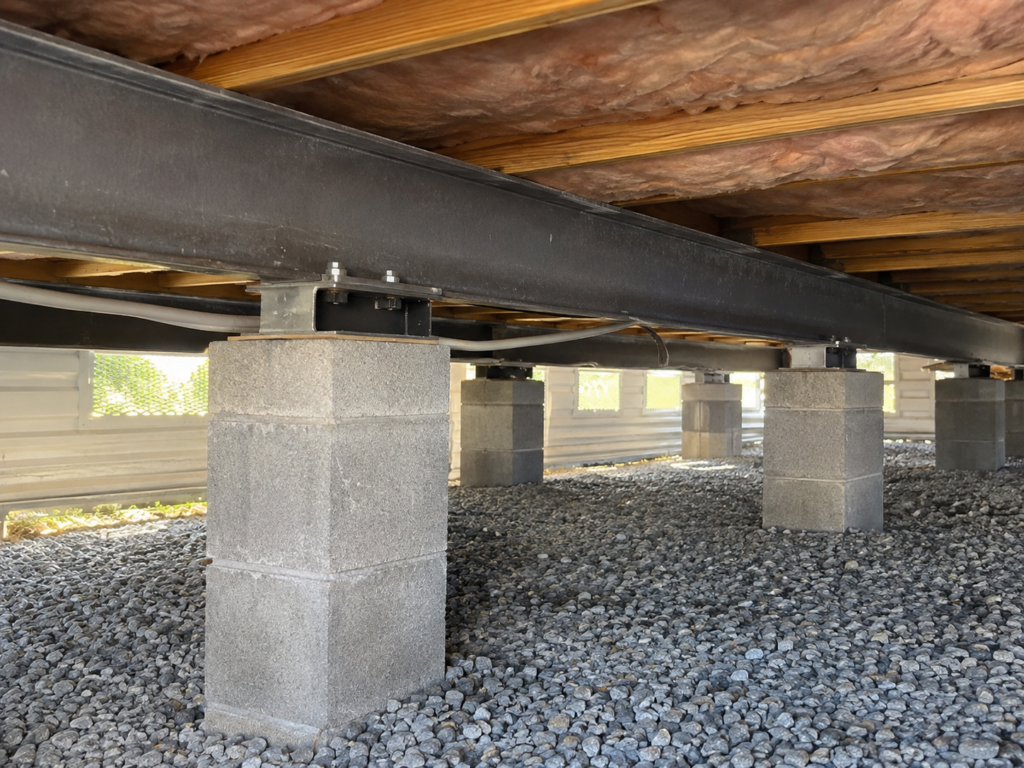
- Measure: The crew opens up access to the crawl space and sets a water level to the bottom of the I-beam at the nearest pier, then measures every other pier setting against that height to see which piers have dropped or risen.
- Adjust: Using the average height across all pier settings, the crew raises or lowers the I-beam at each pier to match. Cracked or worn-out piers, pads, and shims are replaced as needed.
- Verify: The crew confirms the home is level and every pier is carrying its share of the weight before leaving. If your home needs new or upgraded tie-downs, this is the time to install them, because anchoring should always go on a level home.
Our licensed, bonded, and insured installers are certified and bring more than 30 years of experience to every job. We don’t offer a warranty, because no one controls the soil, but we guarantee your home is level when we drive away.
A point worth repeating: this process corrects the steel I-beams and the primary support frame. It doesn’t address localized floor humps, soft spots, or dips. If a bedroom floor has a dip from a deteriorated joist or damaged subfloor, that will still be there after re-leveling, because it’s a separate repair. Learn more about our mobile home re-leveling service.
Schedule Your Re-Level
Most homeowners who call us already know something is wrong. They’ve been living with a sticking door or a tilted floor long enough that the question isn’t whether to deal with it. They want to know how serious it is and what it will take to fix.
Contacting your local On Level provider gets you a free quote with no obligation. We’ll walk you through our published pricing and any add-ons, and when we’re at your home we check pier condition, frame alignment, and tie-downs so you know exactly what’s happening beneath your home.
On Level Services brings more than 30 years of manufactured home experience to homeowners across six regions: North Western Washington, Eastern Washington & Northern Idaho, Portland, OR – Vancouver, WA, East Cascade Slope, WA, Colorado, and Florida. Find the On Level provider nearest you.